Posts

Showing posts with the label experience

Ora et labora

 O nce there were two novices working in the field, and they heard the bells ring for the Angelus. While one of them began to pray immediately, the other quickly lit a cigarette first. "Hey!" cried the first novice indignantly. "I asked the prior if I could smoke while I prayed and he said no!" "That's where you went wrong," replied the second, puffing away. "I asked prior if I could pray while I smoked, and he said yes." Jokes aside, sometimes it's hard to remember to pray the Masses we work for, especially if we are tucked away in a loft or a corner. Responsibilities will tug the corners of our mind, changes might need to be made and communicated, or just plain performance nerves get in the way. I have sat in the choir loft of many a restless choir director, as well as tried to manage my own ADHD while balancing presence for the job at hand with presence for the Holy Sacrifice of the Mass. The struggle is real, whether you are a choir m...
Let's talk typesetting

Image
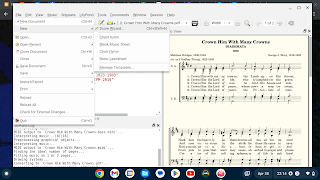
At some point in your music career, you may find yourself wishing: a) you had the arrangement from this  book set with the words from  that  book, or  b) you could find the sheet music for that thing you remember, or  c) for a legible replacement for an ancient photocopy whose original is lost to time, or d) maybe, maybe , to have gorgeous legible sheet music of something you wrote. Perhaps you check what the current top-of-the-line cadillac music engraving software is going for, and the price makes you goggle. Perhaps you download a free trial of Finale Notepad and that's made you swear off sheet music making forever. Perhaps you think about trying out MuseScore, like all the cool kids are doing, but then you hear about their somewhat shady subscription tricksies  or sketchy copyright practices and you'd rather just steer clear. (I should mention that all of the above are my experiences.) The software engine I use to create my scores is called LilyPond , a...

What Does It Take?

Obviously, when someone is chosen to direct or perform music for the liturgy, the first consideration is musical ability. (OK, maybe sometimes availability is a prior concern, but let's hope that musical ability is important to your superior too.) But that's not the only thing that determines whether or not you do the job well.  There's another quality, beyond musical ability, that is crucial to your future as an excellent liturgical musician - I call it Game . Whether you're the organist, the choir director, the cantor, or a single soprano in a vast sea of sopranos, to some degree you have taken a step to put yourself out there.  Congratulations! It's a leap of faith, and it can be hard to make! The further out front you are, the more obvious it is when you make mistakes, as everyone inevitably will. You can insulate yourself from fear a little by being prepared, but you have to acknowledge at the outset that You Will Make Mistakes And People Will Notice .  The onl...

Things Go Wrong

(Posted with my choir members' permission.) Since I'm trying to help you figure out what to do, and why it's important, I tend to focus a lot on The Ideal. Just in case you think that The Ideal is somehow attainable, and therefore you are failing desperately since you can't seem to reach it, I'm going to tell you what it's really like. Good liturgy, just like good theater, involves staying in character. Mistakes get made, but you can't say "Oh whoops, I mean this instead" or it distracts from the liturgy. This is especially true when you're working with others.* On Holy Thursday , I completely forgot to put numbers up on the board for the congregation, and when I began to announce the opening hymn, I had to stop mid-sentence and flip through the book to find the number. Then at the end, I announced that we were going to sing Pange Lingua in English, then in Latin, even though I don't like our translation. We didn't have time for any Lat...

I Went to the Chrism Mass!

I have a Ritual Mass Bucket List. Before I am called into the Heavenly Liturgy, I hope to attend as many different ritual Masses here on Earth as I can, and this week, I got to cross another off my list: the Chrism Mass. I didn't even know there was such a thing as a Chrism Mass until a few years ago, and thus I shouldn't have been surprised that a majority of the people I excitedly told about it replied "The what? What's a Chrism Mass?" So, forgive me if I now make the opposite mistake and tell you all about it. The Chrism Mass is a special Ritual Mass that is supposed to be celebrated on the morning of Holy Thursday (but for pastoral reasons may be held earlier in Holy Week), at the cathedral, by the bishop. Priests of the diocese attend*, fully vested, in order to commemorate the institution of the Sacrament of Holy Orders by renewing their priestly vows in the same way that we the faithful renew our baptismal promises at the Easter Vigil. The evening Mass, the...

Holy Week is Awesome (and so is All This Music) - NOW with links to EIGHTEEN pieces of music

(This post took me days, and I realize that I am now posting it a little too late to be especially useful, but once it's on the Internet, it will be here forever - or at least until next year. Plus hey, some people may still be scrambling to figure this out! Who's going to help them if I won't?) Holy Week is the pinnacle of the music director's year. It's an incredibly taxing undertaking for a chorister or organist, let alone a choir director, and so it should be! This is the Big Game, the Final Exam, the Master Work for the liturgical musician. It would be pretty stupid if it was an easy toss. Suitable music can make the difference between a deeply moving experience and just another week before Easter with extra long gospel readings, so let's dig in. You can skip between sections if you're looking for a particular liturgy, I've included all of them!  Palm Sunday I'm going to assume that you're preparing for the Solemn Entrance form 1. (This is d...

Communion for the Musicians

 The tricky question of how to get the musicians to Communion can be answered in almost as many ways as there are parishes. The best arrangement for you and your parish depends on various parish practices surrounding the distribution of Communion, and the number of musicians involved. The main difficulty is finding a way to avoid gaps in music while also making sure everyone gets to receive without drawing too much attention. The Important Thing is that everyone knows what is going to happen ahead of time. Unless you have access to the premium option, Having Communion Brought To You By A Dedicated Minister, your options are limited to Going First, Going Last, and Going Later - i.e. tracking down the priest or a Eucharistic minister after Mass to distribute Communion. Obviously, this last avoids gaps the best, but also is the most effort, and doesn't always work out. I'll just throw out a whole bunch of ways we've made Going First or Going Last work in our parish at differen...

Rehearsal Practices

Here is a non-comprehensive list of practices I have found to make choir rehearsals more effective and efficient. I am not an efficiency expert by any means - the rehearsals at which I preside often side-track, but that's just my personal directing style . However, when the choir needs to buckle down and do some Hard Work, I have some cards up my sleeve. Find the right time of day . Schedules are a choir director's biggest challenge. If you are directing a parish choir of mostly adults or older students, you're almost certainly going to land on a weekday evening. Be sensitive to your singers' mental cutoff point - ours is 8:45. If your choir members stop processing after 9pm, you won't accomplish anything by pushing on to Just One More Time. For those big pre-Major-Feast rehearsals, make it a morning; twice a year I bribe my choir with coffee and donuts and sing for three hours on a Saturday morning, once before Christmas and once before Holy Week. Those are always ...

Graduated Solemnity

 " Graduated Solemnity " is a concept my pastor is very fond of. (I think we might have different ideas of what, exactly, it entails, but we don't disagree - just what it means to a pastor and what it means to a choir director require slightly different responses.) In theory, it means you put a little extra into feasts, and a lot extra into Solemnities, to make them stand out from Ordinary Time. In practice, it means you put a little less  into the umpteenth Sunday in Ordinary Time, and even less into the third Sunday of Lent. It doesn't mean that you don't do as good a job as you can do, but it does mean that you hold something back, special for the Big Days. What that looks like in your parish depends on your resources. Of course the basics are all there: your music is always dignified, you always make it your mission to convey The Words, and you bring the highest standards of musicianship you've got to the altar. For the pastor, he might order up incense fo...

Quick Hit

 Hey, so, I'm just throwing all the Things I Wish I'd Thought Of Earlier out there, hoping that someone else will find them helpful, but everyone's situations and challenges are unique. If you have questions or issues that you'd like to read something about, comment! Here, another post, anywhere on the blog. I'd be thrilled to do a more directed post than "whatever was on my mind today." Thanks for reading! -Kathleen

Songs I Never Sing (and Why)

 I'm going to get a little nitty and gritty now. There is a whole lot of "classic" "contemporary" "Catholic" music that I ignore whenever possible, and I get asked about them frequently.* I have some very practiced answers that you might find useful if you agree with me. Top offenders: Be Not Afraid, You Are Mine, Here I Am Lord, On Eagle's Wings, Gather Us In, One Bread One Body... you get the idea. What are those scare quotes - classic, contemporary, Catholic - up there all about? Well, all three of those descriptors are false. These songs have not earned the label of classic because they are too young - the tradition of the Church is way too big for songs written in living memory to be considered "classics" yet, not alongside thousand-year-old poetic masterpieces. They've outgrown the label of contemporary by being too dated. And many of them don't get the label "Catholic" because they are theologically suspect at bes...

So, what's this all about, then?

  Me, personally My name is Kathleen, and I’m the music director at a Catholic parish in a small college town in Southern California. During my 20+ years at this parish and throughout my whole lifetime of liturgical music, I’ve worn many different hats - organist, choir member, cantor, choir director, person who chooses the music, person who manages the music staff - so I can speak from many different perspectives. My experience is my main qualification - I am the owner of zero pieces of paper validation except for a certificate of completion of the kind of Child Safety Training I’m sure most of my target readership is painfully familiar with. But I’ve studied a lot, thought a lot, had a lot of discussions with a lot of thoughtful people, and tried a lot of different things, so I do hope that my experience and perspective will be helpful. I do have one publication to my name: a  hymnal for Catholic schools  that I helped edit for the  Institute for Catholic Liberal E...