Posts

Showing posts with the label practical

Ora et labora

 O nce there were two novices working in the field, and they heard the bells ring for the Angelus. While one of them began to pray immediately, the other quickly lit a cigarette first. "Hey!" cried the first novice indignantly. "I asked the prior if I could smoke while I prayed and he said no!" "That's where you went wrong," replied the second, puffing away. "I asked prior if I could pray while I smoked, and he said yes." Jokes aside, sometimes it's hard to remember to pray the Masses we work for, especially if we are tucked away in a loft or a corner. Responsibilities will tug the corners of our mind, changes might need to be made and communicated, or just plain performance nerves get in the way. I have sat in the choir loft of many a restless choir director, as well as tried to manage my own ADHD while balancing presence for the job at hand with presence for the Holy Sacrifice of the Mass. The struggle is real, whether you are a choir m...
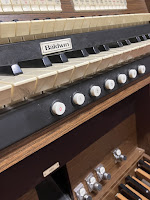
5 Quick Tips (5QT) to Make You a Better Accompanist Today

Image
 When I first started writing this blog, I had a plan of sorts, which included periodic "5 Quick Tips" to improve your performance at every different job in liturgical music. This is not an earth-shaking list, it's literally just bite-sized habits you can incorporate to make things a little easier on yourself. Try working on one new little habit per month. Let's begin with the Organist: 1. Hit the "Cancel" button after every hymn. No mistake feels more conspicuous than stepping on a pedal by mistake when there are stops open. Those keys are sensitive, man. Make it a habit to turn everything off between pieces. (My five-year-old likes to sit on the bench next to me, and pressing the cancel button is his job.) 2. Choose your tempo before  beginning the intro. Changes in tempo make the congregation uncertain. An uncertain congregation is a silent congregation. Count yourself in, start playing at the tempo you intend to use throughout, and stick with it. Don...

Let's talk typesetting

Image
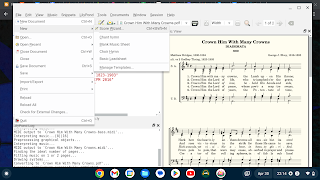
At some point in your music career, you may find yourself wishing: a) you had the arrangement from this  book set with the words from  that  book, or  b) you could find the sheet music for that thing you remember, or  c) for a legible replacement for an ancient photocopy whose original is lost to time, or d) maybe, maybe , to have gorgeous legible sheet music of something you wrote. Perhaps you check what the current top-of-the-line cadillac music engraving software is going for, and the price makes you goggle. Perhaps you download a free trial of Finale Notepad and that's made you swear off sheet music making forever. Perhaps you think about trying out MuseScore, like all the cool kids are doing, but then you hear about their somewhat shady subscription tricksies  or sketchy copyright practices and you'd rather just steer clear. (I should mention that all of the above are my experiences.) The software engine I use to create my scores is called LilyPond , a...

The Christmas Vigil Mass

Christmas is one of those feasts where I have had a very hard time settling on the exact right music. Everyone wants to hear Classic Christmas Carols, and Christmas is a time when people crave the familiar and the comfortable. They aren't looking to hear the themes of the readings match up with the themes of the music, they just want to get their kids to Mass and hear the story of the baby in the manger and sing some songs and follow all of their cherished family traditions. But we're Liturgists! We can give them so much more, and we don't even have to jolt them out of their Holiday Zones. How can this be accomplished? The massive Solemnity of the Nativity of the Lord comes in four parts: the Vigil, the Mass at Midnight, the Mass at Dawn, and the Mass During the Day. They all have their own special focus and character, and the readings and antiphons are different for each one. At Midnight, we get the narrative of the birth of Jesus from the census decree through to the ange...

On Funerals

This is a sort of meta-post about the purpose of funerals and their structure. Tune in next time for more concrete suggestions and printable music you can use! Nothing brings out my Expert's Ire like watching the portrayal of Catholic funerals on TV - kind of like the way my husband spends all of every submarine movie muttering "it never looks like that" or "that would never happen." No one wants to talk about death anymore, and so the Catholic Church's teaching on Last Things is often left to one side until one must face it personally, leaving vast numbers of people without any knowledge of how the funeral liturgy works, or even what it is for. Add into that the grossly misrepresented "Christian Funeral" on almost every form of modern media, and you have a situation rife with highly uncomfortable encounters for the organist or cantor. There are few trickier situations to navigate than a funeral liturgy. On the one hand, the raw feelings of the ber...

The Sequence (with music!)

There are a few major feasts in the church year that are distinguished by the addition of a Sequence to the liturgy: Easter, Pentecost, Corpus Christi, and Our Lady of Sorrows . What is a Sequence, and what is it for? It's a piece of theological poetry, based in scripture but not directly taken from it, which forms one of the lessons for the day. I like to think of it as a kind of homiletic fail-safe - no matter how good or bad a preacher your pastor is, you will get this one elegant lesson that encapsulates all you have to know about the feast. In the Ordinary Form, it is sung between the second reading and the Gospel Acclamation.  While two of the Sequences are optional, the ones for Easter and Pentecost must be at least recited - but they are so much better when sung. Since the Sequence is a lesson, similar to the readings, I think it is best to sing it in the vernacular - at the very least, the congregation should have the translation in their hands. If it is not printed in t...

How to Pick Music

 I've gone over some general guidelines for choosing music before, but after having talked to a few people since then, it seems like it would be helpful to have more detailed instructions. I don't have the same resources as you, so I'll keep it broad, but hopefully this will still help. Step One: Organize. Use a spreadsheet program or a word processing program to set up a monthly music planner. Include columns for the date, the Entrance, Offertory, Communion, and Recessional (also a Meditation slot, if you want - I just put mine in the Communion cell). Put the month and year at the top, and include the year of the liturgical cycle you are on, if you are feeling fancy. I saved a blank one as a template, so that every time I want to make one, I can click "create new" and choose the template from the list and away we go. (I'd share my template with you except that I use a mac for my planning computer and a chromebook for my blogging and typesetting, so who am I ...

What Does It Take?

Obviously, when someone is chosen to direct or perform music for the liturgy, the first consideration is musical ability. (OK, maybe sometimes availability is a prior concern, but let's hope that musical ability is important to your superior too.) But that's not the only thing that determines whether or not you do the job well.  There's another quality, beyond musical ability, that is crucial to your future as an excellent liturgical musician - I call it Game . Whether you're the organist, the choir director, the cantor, or a single soprano in a vast sea of sopranos, to some degree you have taken a step to put yourself out there.  Congratulations! It's a leap of faith, and it can be hard to make! The further out front you are, the more obvious it is when you make mistakes, as everyone inevitably will. You can insulate yourself from fear a little by being prepared, but you have to acknowledge at the outset that You Will Make Mistakes And People Will Notice .  The onl...

On Working With Priests

(This article is primarily aimed at music directors, but applies at least a little to every parish musician.) Ah yes. If you work for the Catholic Church, you will have to know how to work with priests. This is a special power hierarchy dynamic that you don't get in the workplace in other jobs. It's a little bit like how I imagine working with princes would be - there is more at play than the person himself. Depending on your own position in the parish, you will have to work with Fr Person, Fr Pastor, and Fr Persona Christi. (And sometimes Fr Confessor, so if you grouch or gossip about your pastor, this can get awkward fast. Ask me how I know.) When in a meeting with your pastor, remember your respective positions. By virtue of the sacrament of Holy Orders, Fr Pastor has grace of state to guide his flock. That doesn't mean he can't be wrong, but it does mean that it is wrong to work against him. (There are always at least fifty times more things going on in your parish ...

The Words (plus a bonus Hymn!)

 I keep saying, in various posts, that the primary job of the liturgical musician is The Words (yes, even the organist ). What does that mean, and how does it work? My first organ teacher (who was a fabulous teacher) told me that my job as organist in a Catholic parish was to provide "auditory wallpaper" to provide a devout and prayerful ambiance to the liturgy. She was wrong. Such an approach trivializes the liturgy as a mood or feeling to experience. Were this to be true, then the current "anything goes" attitude towards liturgical music would be valid; personal taste and changing moods would force the liturgy to be subject to the whims of the music director, depriving it of its universal character, making it more or less valid according to how much or how little that particular musical style moved each participant. The liturgy would cease to be a Thing That Is Given, and instead would become a Look What I Made, Yay Me. (That's clearly not the way it is, ther...

Rehearsal Practices

Here is a non-comprehensive list of practices I have found to make choir rehearsals more effective and efficient. I am not an efficiency expert by any means - the rehearsals at which I preside often side-track, but that's just my personal directing style . However, when the choir needs to buckle down and do some Hard Work, I have some cards up my sleeve. Find the right time of day . Schedules are a choir director's biggest challenge. If you are directing a parish choir of mostly adults or older students, you're almost certainly going to land on a weekday evening. Be sensitive to your singers' mental cutoff point - ours is 8:45. If your choir members stop processing after 9pm, you won't accomplish anything by pushing on to Just One More Time. For those big pre-Major-Feast rehearsals, make it a morning; twice a year I bribe my choir with coffee and donuts and sing for three hours on a Saturday morning, once before Christmas and once before Holy Week. Those are always ...

Graduated Solemnity

 " Graduated Solemnity " is a concept my pastor is very fond of. (I think we might have different ideas of what, exactly, it entails, but we don't disagree - just what it means to a pastor and what it means to a choir director require slightly different responses.) In theory, it means you put a little extra into feasts, and a lot extra into Solemnities, to make them stand out from Ordinary Time. In practice, it means you put a little less  into the umpteenth Sunday in Ordinary Time, and even less into the third Sunday of Lent. It doesn't mean that you don't do as good a job as you can do, but it does mean that you hold something back, special for the Big Days. What that looks like in your parish depends on your resources. Of course the basics are all there: your music is always dignified, you always make it your mission to convey The Words, and you bring the highest standards of musicianship you've got to the altar. For the pastor, he might order up incense fo...

Songs I Never Sing (and Why)

 I'm going to get a little nitty and gritty now. There is a whole lot of "classic" "contemporary" "Catholic" music that I ignore whenever possible, and I get asked about them frequently.* I have some very practiced answers that you might find useful if you agree with me. Top offenders: Be Not Afraid, You Are Mine, Here I Am Lord, On Eagle's Wings, Gather Us In, One Bread One Body... you get the idea. What are those scare quotes - classic, contemporary, Catholic - up there all about? Well, all three of those descriptors are false. These songs have not earned the label of classic because they are too young - the tradition of the Church is way too big for songs written in living memory to be considered "classics" yet, not alongside thousand-year-old poetic masterpieces. They've outgrown the label of contemporary by being too dated. And many of them don't get the label "Catholic" because they are theologically suspect at bes...

So You Want To Be An Organist

 Maybe you've been conscripted into playing the organ at your parish because word got out that you play piano (same thing, right?) and there's a hole to fill. Maybe your parish currently uses a piano and there's an organ just  sitting there  and you have a vague sense that it would be more fitting. Maybe, just  maybe,  you're actually a classically trained organist and for once, someone is offering you money to play. Any way you look at it, playing the organ for your parish is a bit of a different animal from whatever you've been doing before. So first, some words on why the organ is So Great, so much better than any other instrument (including the omnipresent piano) and why you should use it in the liturgy. Three things set the organ apart. Firstly, it breathes like a singer, and sustains notes the way a singer does - its ability to hold prolonged phrases without sound decay or having to resort to "filler" notes maintains the sense of the musical line wit...