Posts

Ora et labora

 O nce there were two novices working in the field, and they heard the bells ring for the Angelus. While one of them began to pray immediately, the other quickly lit a cigarette first. "Hey!" cried the first novice indignantly. "I asked the prior if I could smoke while I prayed and he said no!" "That's where you went wrong," replied the second, puffing away. "I asked prior if I could pray while I smoked, and he said yes." Jokes aside, sometimes it's hard to remember to pray the Masses we work for, especially if we are tucked away in a loft or a corner. Responsibilities will tug the corners of our mind, changes might need to be made and communicated, or just plain performance nerves get in the way. I have sat in the choir loft of many a restless choir director, as well as tried to manage my own ADHD while balancing presence for the job at hand with presence for the Holy Sacrifice of the Mass. The struggle is real, whether you are a choir m...
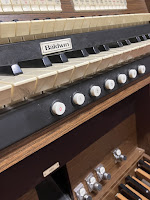
5 Quick Tips (5QT) to Make You a Better Accompanist Today

Image
 When I first started writing this blog, I had a plan of sorts, which included periodic "5 Quick Tips" to improve your performance at every different job in liturgical music. This is not an earth-shaking list, it's literally just bite-sized habits you can incorporate to make things a little easier on yourself. Try working on one new little habit per month. Let's begin with the Organist: 1. Hit the "Cancel" button after every hymn. No mistake feels more conspicuous than stepping on a pedal by mistake when there are stops open. Those keys are sensitive, man. Make it a habit to turn everything off between pieces. (My five-year-old likes to sit on the bench next to me, and pressing the cancel button is his job.) 2. Choose your tempo before  beginning the intro. Changes in tempo make the congregation uncertain. An uncertain congregation is a silent congregation. Count yourself in, start playing at the tempo you intend to use throughout, and stick with it. Don...

Let's talk typesetting

Image
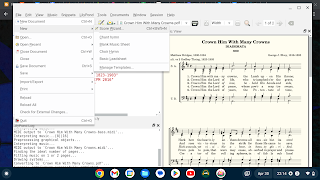
At some point in your music career, you may find yourself wishing: a) you had the arrangement from this  book set with the words from  that  book, or  b) you could find the sheet music for that thing you remember, or  c) for a legible replacement for an ancient photocopy whose original is lost to time, or d) maybe, maybe , to have gorgeous legible sheet music of something you wrote. Perhaps you check what the current top-of-the-line cadillac music engraving software is going for, and the price makes you goggle. Perhaps you download a free trial of Finale Notepad and that's made you swear off sheet music making forever. Perhaps you think about trying out MuseScore, like all the cool kids are doing, but then you hear about their somewhat shady subscription tricksies  or sketchy copyright practices and you'd rather just steer clear. (I should mention that all of the above are my experiences.) The software engine I use to create my scores is called LilyPond , a...

The Christmas Vigil Mass

Christmas is one of those feasts where I have had a very hard time settling on the exact right music. Everyone wants to hear Classic Christmas Carols, and Christmas is a time when people crave the familiar and the comfortable. They aren't looking to hear the themes of the readings match up with the themes of the music, they just want to get their kids to Mass and hear the story of the baby in the manger and sing some songs and follow all of their cherished family traditions. But we're Liturgists! We can give them so much more, and we don't even have to jolt them out of their Holiday Zones. How can this be accomplished? The massive Solemnity of the Nativity of the Lord comes in four parts: the Vigil, the Mass at Midnight, the Mass at Dawn, and the Mass During the Day. They all have their own special focus and character, and the readings and antiphons are different for each one. At Midnight, we get the narrative of the birth of Jesus from the census decree through to the ange...

On Funerals

This is a sort of meta-post about the purpose of funerals and their structure. Tune in next time for more concrete suggestions and printable music you can use! Nothing brings out my Expert's Ire like watching the portrayal of Catholic funerals on TV - kind of like the way my husband spends all of every submarine movie muttering "it never looks like that" or "that would never happen." No one wants to talk about death anymore, and so the Catholic Church's teaching on Last Things is often left to one side until one must face it personally, leaving vast numbers of people without any knowledge of how the funeral liturgy works, or even what it is for. Add into that the grossly misrepresented "Christian Funeral" on almost every form of modern media, and you have a situation rife with highly uncomfortable encounters for the organist or cantor. There are few trickier situations to navigate than a funeral liturgy. On the one hand, the raw feelings of the ber...

Hymn of the Week: Praise to the Lord, the Almighty (LOBE DEN HERREN)

 Hymn Title : Praise to the Lord, the Almighty Tune Name : LOBE DEN HERREN Meter : 86.86.4.7.8. An absolute staple hymn, Praise to the Lord has been published in 376 different hymnals, according to Hymnary.org - and it deserves this widespread fame. With a metrical pattern that only a German Chorale Master could dream up, you won't find any other text set to this tune, nor this tune with any other set of words. So why am I bothering to make it available to you, when I could be featuring other, more obscure hymns? Well, because I want to draw your attention to it - sometimes a gold standard gets cast aside as "too common," and falls out of use. Also your hymnal might have watered the words down, and we can't have that. LOBE DEN HERREN is a strong, singable tune, with a solid, rational arrangement. The long opening lines should be sung in one breath if possible, which should give you a sense of the kind of brisk tempo this piece demands, unless you are in a large, espec...

Hymn of the Week: The Church's One Foundation (AURELIA)

 Hymn Title: The Church's One Foundation Tune Name: AURELIA Meter: 76 76 D Andrew Seeley writes in Golden Treasures  (the companion volume to Classic Hymns For Catholic Schools ): "Many of the traditional doctrines of the Catholic Church are shared by our separated brethren. This hymn [The Church's One Foundation], one of the richest in English celebrating the Church, was written by an Anglican clergyman in South Africa and is sung to a tune composed by the grandson of Charles Wesley, founder of the Methodist Church. But the reverence for the Church, the Scripturally-rich imagery, the connection with history and eternity make this an eminently Catholic hymn."* There seems to be a dearth of modern Catholic "hymns" about the Church that are actually Christ-centered. I suppose that the dreaded "Spirit of Vatican II" (which has very little to do with the teachings  of Vatican II) told us that we should turn our attention to ourselves and celebrate t...

The Liturgical Musician as Teacher

Image
 "He called a child over, placed it in their midst, and said, “Amen, I say to you, unless you turn and become like children, you will not enter the kingdom of heaven." (Mt 18:2-3) Children are amazing. They begin knowing nothing except that they are needy, and over a remarkably short period of time, learn to eat, walk, talk, read, navigate relationships, dress themselves, memorize and repeat an astonishing quantity of information, and so on. For the most part, this is done simply by having things around for them to learn from, by being intentional in speaking to them, and by expecting them to participate to the best of their ability in every day life, correcting gently where necessary. No adult can possibly absorb as much as any average child - our crusty old brains still rely on the patterns acquired in infancy to process and integrate information. Our Mother the Church treats us as the children we are: she places us in a prepared environment  (a beautiful church), speaks to...

Hymn of the Week: The God Whom Earth and Sea and Sky (EISENACH)

 Hymn Title: The God Whom Earth and Sea and Sky Tune Name: EISENACH Meter: LM (88 88) As we are coming up on the Feast of the Assumption (a holy day of obligation... unless your diocese habitually lifts the obligation for feasts that fall on a Monday or Saturday, lest people have to attend Mass two days in a row ), it's time to reach into your Marian Hymn Box. Oh, what have we here? A hymn to our Blessed Mother that isn't Hail Holy Queen or Immaculate Mary? Sign me up! The trick to using Marian hymns in the Mass* is to make sure that at least some of the time, they are addressed to God. If the antiphon for which you are substituting a hymn is addressed to Mary, you may use a hymn addressed to Mary. Otherwise, you want one like this one, which concludes: O Lord, the Virgin-born, to thee eternal praise and glory be, whom with the Father we adore and Holy Spirit evermore. This is not out of any disrespect to Mary, of course! But if you were at a wedding, and found that all the ...

Resource Review: Worship 4

My overall rating: 2.5/5 Content:  2/5 Book Quality: 4/5 Ease of use: 3/5 Musicality: 2/5 Summary: has some good stuff but won't be everything your parish needs, making it a very expensive supplement. The Worship hymnal line from GIA Publications has been one of their flagship resources for a really, really long time. The fourth edition was published in 2011, so as to include the new translation of the Novus Ordo. Their site rates it as "80% traditional, 20% contemporary," so it's clear that they don't use the same metric as I do for that divide. Per their website, " Worship IV is filled with the finest organ-based hymnody GIA has to offer. " I don't doubt that this is true. the Good There's a ton of stuff in here. There are over 1200 separate pieces of music, encompassing hymns and canticles for the Liturgy of the hours, eight complete Mass settings, alternate psalm settings, traditional hymns, contemporary works, and more. The accompanimen...

I Had This Idea

People keep telling me that they can't join the choir because they don't read music. Well, reading music is nice, but not necessary, depending on the level of musicianship and the difficulty of the music in your parish choir. But it got me thinking... what if they could? So I asked my pastor for a minute at the end of each Mass one weekend to make "an announcement." (To be fair, if he didn't want me to go on for a bit, he should have said no - he's seen the length of my previous "announcements," so it's on him, really.) Below is the text of the announcement I gave: "Hello, my name is (Kathleen), and I am the director of music here at (church). For over 20 years, it has been my honor to help enrich the liturgical life of this wonderful parish, with the help of a team of dedicated and talented musicians. I’m not actually here to recruit you to join the choir - in fact, the choir is just about to take their summer break, so that announcement wi...

Hymn of the Week: I Bind Unto Myself Today (Updated music!)

 Hymn Title: I Bind Unto Myself Today Tune Name: ST PATRICK"S BREASTPLATE / DIERDRE Meter: LMD (Long Meter Double, that is, 88 88 two times) The first hymn I put up on this site was a fine example of an old Irish lorica  or prayer of protection. This one is the Big Great Grandaddy of all Old Irish Loricas, named the breastplate of St Patrick. If hymns were people, this one would be a legendary general. If hymns were food, this one would be an entire banquet. If hymns were dwelling places, this one would be a fortress. Performance of this wonder should not be undertaken without preparation - it's hard to know what is going on and when, unless everyone has looked over the music together at least once. The first verse is a shortened version of the subsequent verses, so I have typeset it first by itself, outside of the repeats. Then, you may notice that the remaining verses are numbered 2-5, then 7. This is because, not content to be a great hymn, this one sidetracks for the s...

Hymn of the Week(ish): Crown Him With Many Crowns

  Hymn Title: Crown Him With Many Crowns Tune Name: DIADEMATA Meter: SMD (that is, Short Meter, Double - 6.6.8.6. 6.6.8.6.) There is no better example of the power of hymnodal language than Crown Him With Many Crowns. A vigourous, commanding text wedded to a trimphant hymn tune, just begging for a trumpet fanfare, this gem is often found to be the victim of misguided modern verbal castration: cut, sanded, watered down, and just... weakened. However, here it is, in its original lyrical glory - note especially the third verse, my favourite: "Crown him the Lord of Love, Behold his hands, his side; Rich wounds yet visible above, In beauty glorified. No angel in the sky Can fully bear that sight, But downward bends his burning eye At mysteries so bright." And I can never resist a big dopey grin when singing the phrase "Creator of the rolling spheres / Ineffably divine." It's just too much. A real poetic masterpiece. And the music! A joy to the rational soul, the p...

The Sequence (with music!)

There are a few major feasts in the church year that are distinguished by the addition of a Sequence to the liturgy: Easter, Pentecost, Corpus Christi, and Our Lady of Sorrows . What is a Sequence, and what is it for? It's a piece of theological poetry, based in scripture but not directly taken from it, which forms one of the lessons for the day. I like to think of it as a kind of homiletic fail-safe - no matter how good or bad a preacher your pastor is, you will get this one elegant lesson that encapsulates all you have to know about the feast. In the Ordinary Form, it is sung between the second reading and the Gospel Acclamation.  While two of the Sequences are optional, the ones for Easter and Pentecost must be at least recited - but they are so much better when sung. Since the Sequence is a lesson, similar to the readings, I think it is best to sing it in the vernacular - at the very least, the congregation should have the translation in their hands. If it is not printed in t...

Hymn of the Week: Come, Ye Faithful, Raise the Strain

 After a restful Easter Octave and replete with feasting (and now improved by the addition of five solid pounds of Easter Joy to my frame), I am back with more Hymns of the Week to broaden your repertoire! Hymn Title: Come, Ye Faithful, Raise the Strain Tune Name: GAUDEAMUS PARITER Meter: 76 76 D (D for "double," so 7.6. 7.6. 7.6. 7.6.) A bright, dance-like Easter hymn, Come Ye Faithful plays a few rhythm tricks to liven up its simple tune and harmonies. Although there is no time signature written, it alternates between 2/2 and 3/2 - it's not too hard to figure out which part is which. Definitely  remember to keep it in 2, though, or it will be way too slow. (The original manuscript has each phrase ending with two half notes with a fermata, but I translated that into a 3/2 bar with a half note and a whole note for clarity.) The lyrics draw a strong parallel between the events of Exodus and the Paschal mystery, making this hymn a solid choice for days when the antiphons...

How to Pick Music

 I've gone over some general guidelines for choosing music before, but after having talked to a few people since then, it seems like it would be helpful to have more detailed instructions. I don't have the same resources as you, so I'll keep it broad, but hopefully this will still help. Step One: Organize. Use a spreadsheet program or a word processing program to set up a monthly music planner. Include columns for the date, the Entrance, Offertory, Communion, and Recessional (also a Meditation slot, if you want - I just put mine in the Communion cell). Put the month and year at the top, and include the year of the liturgical cycle you are on, if you are feeling fancy. I saved a blank one as a template, so that every time I want to make one, I can click "create new" and choose the template from the list and away we go. (I'd share my template with you except that I use a mac for my planning computer and a chromebook for my blogging and typesetting, so who am I ...

What Does It Take?

Obviously, when someone is chosen to direct or perform music for the liturgy, the first consideration is musical ability. (OK, maybe sometimes availability is a prior concern, but let's hope that musical ability is important to your superior too.) But that's not the only thing that determines whether or not you do the job well.  There's another quality, beyond musical ability, that is crucial to your future as an excellent liturgical musician - I call it Game . Whether you're the organist, the choir director, the cantor, or a single soprano in a vast sea of sopranos, to some degree you have taken a step to put yourself out there.  Congratulations! It's a leap of faith, and it can be hard to make! The further out front you are, the more obvious it is when you make mistakes, as everyone inevitably will. You can insulate yourself from fear a little by being prepared, but you have to acknowledge at the outset that You Will Make Mistakes And People Will Notice .  The onl...

Things Go Wrong

(Posted with my choir members' permission.) Since I'm trying to help you figure out what to do, and why it's important, I tend to focus a lot on The Ideal. Just in case you think that The Ideal is somehow attainable, and therefore you are failing desperately since you can't seem to reach it, I'm going to tell you what it's really like. Good liturgy, just like good theater, involves staying in character. Mistakes get made, but you can't say "Oh whoops, I mean this instead" or it distracts from the liturgy. This is especially true when you're working with others.* On Holy Thursday , I completely forgot to put numbers up on the board for the congregation, and when I began to announce the opening hymn, I had to stop mid-sentence and flip through the book to find the number. Then at the end, I announced that we were going to sing Pange Lingua in English, then in Latin, even though I don't like our translation. We didn't have time for any Lat...

Hymn of the Week: The Strife is O'er (VICTORY)

(I buried this hymn in the Holy Week Music post, but it deserves to be in the spotlight.)   Hymn Title: The Strife is O'er Tune Name: VICTORY Meter: 888 with Alleluias Stately, triumphant, joyful, sounds great with the organ turned All The Way Up - what more could you ask for in an Easter hymn? We round out our Triduum with this piece, because it requires very little focus, and if the choir members are tired (which they are), they can let the organ support them as much as they need. Still, the rising Alleluias in the refrain always seem to reach down deep inside them and find as yet untapped stores of energy for bursting forth in song, somehow. We sing all five verses, and the congregation always stays to sing, many of them even staying for the organ postlude, despite the late hour. This arrangement pretty much speaks for itself, except that I seem to need to remind my choir from time to time to be careful not to "yip" the ends of their Alleluias. There is plenty of ti...

Lighten Up!

Christ is Risen! Alleluia! Because I kind of overloaded on music postings last week, I'm just going to share a piece of choir humour today. How many sopranos does it take to change a light bulb? - Just one: she holds the light bulb and the world revolves around her. How many altos does it take to change a light bulb? - Two: one to climb up and change the bulb, and one to ask "isn't that a bit high for you, dear?" How many tenors does it take to change a light bulb? - Ten: one to change the bulb, and nine to say "Oh, I could have done that." How many basses does it take to change a light bulb? - Basses don't change light bulbs, they prefer to stumble about in the dark, bonking their shins on things. How many choir directors does it take to change a light bulb? - No one knows, because no one ever watches the choir director. How many organists does it take to change the bulbs in a chandelier? - Just one: he changes two with each hand and one with his feet. ...